Home→Sing on the Page: Poetry Resources and Activities for Teens
Sing on the Page: Poetry Resources and Activities for Teens
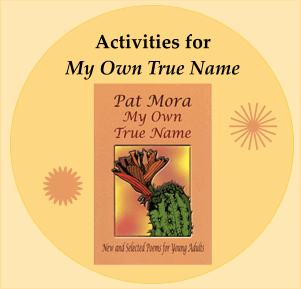
"Where do you get your book ideas?" audiences sometimes ask. Both of my poetry books for teens were suggested by librarians, one in California and one in Texas. I'm grateful to both women since I really enjoyed writing these books. For My Own True Name: New and Selected Poems for Young Adults, published in 2000, I selected poems from my first poetry collections for adults, Chants, Borders and Communion that I thought teens might like, and then I wrote some new poems and the letter intro, "Dear Fellow Writer." It begins, "A blank piece of paper can be exciting and intimidating."
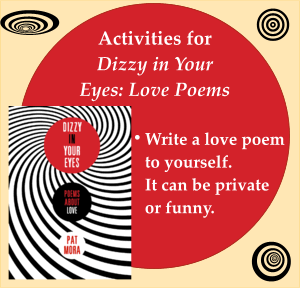
Ten years later, Dizzy in Your Eyes: Poems about Love, a book of all new poems was published. Its intro letter begins, "I love the intensity of the teen years." I'm grateful to the teens around the country who shared their stories and gave me some ideas.
Poetry is my favorite genre. I love the challenge and the economy, writing-and re-writing to find just the right words to share a story or scene or idea. I hope that you enjoy writing poems for yourself, friends and family. Writing poetry makes us all better writers. Writing poetry also takes some quiet and time, I think, like painting or composing a song.
I hope that you enjoy the suggestions below. Please email your ideas for making this teen poetry section more useful to you. Soon, I think I'll begin editing a new collection for teens. Exciting!
Pat
Create a booklet of love poems for someone - girlfriend/boyfriend, friend, family or relative. The poems you include can be original, copied from poetry books (appropriate credit given) or a combination of original and other sources. Illustrate your booklet with collage, photos, paint or other media.
Choreograph a dance to a poem or a "suite" of poems or pick a poem to set to music. Enjoy it by yourself or share it with friends.
Play the song game: Each player chooses a love song he/she likes and types the lyrics. The group trades songs, and silently everyone reads the lyrics they have at least twice. Next, each player reads the lyrics aloud to the group. The first person to call out the title, gets a point. To discuss later: How different are the lyrics without the music?
Organize a Poetry Slam for the next Valentine's Day.
Schedule a group reading of love poems at an assisted living facility for next Valentine's Day.
Odes are praise songs. Read "Ode to Pizza" as well as some of the odes written by Nobel Prize winner Pablo Neruda. Write an ode about or to something concrete (sunflowers) or abstract (freedom) or to someone you like or love.
Like cheese? I do. Again using "Ode to Pizza" as an example, write a poem about a favorite food. Select one important word in the poem and use numerous translations of that word in your poem.
Read one or two of the poems out loud. Read them again and jot down a 3-5 words that appeal to you. Use those words to trigger a new poem.
Ideas for poems sometimes come from stories we hear. Read the poem "Immigrants/Los inmigrantes." Sometimes readers think that because I'm a Latina writer, I wrote it about a Latina family. The poem was inspired by a friend whose parents were Norwegian. Write a poem inspired by a story you've heard.
The poems in My Own True Name are grouped into the sections "Blooms," Thorns," and "Roots." Select three poems - one from each section - that are linked or complement each other. Design a triptych using the three poems and hang it on your wall.
Write a poem series, maybe three short poems that are about the blooms, thorns, and roots in your life.